 By admin
 Germany has represented itself as one of the largest economies of the European Union, with influential trading nations collaborating. The export-oriented economy is progressing over time due to the advanced industrial base and technological leadership. The strong automotive sector, engineering expertise, pharmaceutical industry, and machinery manufacturing capabilities have supported international competitiveness. The import of a wide variety of energy products, industrial machinery, electronic components, and materials has supported the overall trade ranking of the country. The exports of high-value automobiles, precision machinery, and pharmaceuticals have maintained the trade to more than 200 international markets.
The efficient logistics infrastructure, modern customs administration, and advanced transportation networks have made Germany the most attractive destination for international trade. Germany Import Data have been proven to be valuable shipment-level intelligence because they help businesses identify reliable buyers and suppliers. It even helps the authorities with analysis of sourcing strategies and evaluation of pricing trends. Import Globals categorizes detailed analysis on Germany customs and shipment-level trade intelligence. It enables importers, exporters, manufacturers, and logistics companies to understand the latest trade activities to promote informed decisions while reducing uncertainty in international trade.
THE SIGNIFICANT ROLE OF GERMANY IN GLOBAL TRADE
Germany has maintained its position as one of the largest trading economies because of continuous industrial innovation, engineering excellence, and export-driven economic policies. The manufacturing sector has maintained its contribution to the European Union’s authentic trade integrity with effective supply of advanced products across automotive, machinery, healthcare, and aerospace. Germany has been serving as a central distribution hub mainly due to its strategic geographic location and the highly developed transportation infrastructure.
The world-class seaports, international airports, railway systems, and highway network have facilitated the efficient movement of trade across international borders. The country’s trade relationship with the United States, China, France, the Netherlands, and Italy has maintained its thriving trade ranking. Germany customs data reported the stronger trade influence of the country as the main region supporting the overall trade management. The continuous investment made by the government authorities in Industry 4.0, artificial intelligence, robotics, and electric mobility is a factor supporting the long-term trade competitiveness.
THE COMPREHENSIVE OVERVIEW OF GERMANY IMPORT
Germany import trade data is a valuable asset for the business authorities looking for the latest resourcing potential of the nation. Germany has been mainly importing crude oil, natural gas, industrial machinery, and semiconductors to support domestic manufacturing and industrial production. China, the Netherlands, the United States, Poland, and France are considered the top import authorities. The supply of a diversified range of industrial equipment, electronic components, and chemicals has supported Germany’s manufacturing ecosystem.
The government investment in renewable energy, semiconductor production, and electric vehicle manufacturing has increased the demand rate while supporting the import of industrial equipment, advanced technologies, better materials, and critical minerals. Germany customs data helps businesses with evaluation of supplier performance, analysis of import trends, and identification of sourcing opportunities.
THE EXPORT MARKET OVERVIEW OF GERMANY
The export market is a proper representation of the overall productivity range of the nation. Germany export trade data demonstrates the competitive advantages of the country regarding numerous industrial sectors supported by trade, including advanced engineering and highly skilled manufacturing.
The primary export categories of the nation include automotive components, industrial machinery, pharmaceuticals, chemicals, and electrical machinery. The United States, France, the Netherlands, China, Poland, and Italy are the latest export partners. The international partnerships and the quality control research have shaped the overall trade landscape. The government initiative supporting digital transformation and hydrogen technologies has strengthened Germany’s export competitiveness.
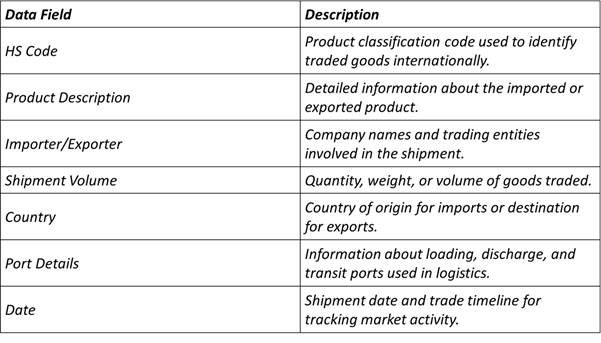
WHAT DETAILS ARE INCLUDED IN GERMANY CUSTOMS DATA?
THE EFFECTIVENESS OF GERMANY IMPORT-EXPORT DATA PROVIDERS IN BUSINESS GROWTH
Reliable Germany import-export data is considered a valuable asset because it helps business authorities with the latest understanding of import and export shipments. It provides authentic customs intelligence that supports verified shipment records. Businesses can properly identify importers, exporters, manufacturers, distributors, and procurement companies to evaluate the global demand patterns for understanding the competitive performance.
The comprehensive shipment-level intelligence helps the authorities with monitoring of the customer purchasing behaviour and optimization of the supply chains along with the evaluation of the pricing strategies. It eliminates the chances of the authorities being reliant on assumptions. Despite this, the companies can make confident strategic decisions that are overall supporting the real customs records.
HOW DOES GERMANY IMPORT-EXPORT TRADE DATA SUPPORT BUSINESS GROWTH?
Germany import-export trade data is considered a valuable business tool for the authorities trying to be progressive because it helps businesses identify reliable buyers and suppliers and evaluate changing market conditions. The availability of authentic German customs records helps the authorities make informed decisions while reducing the risk and strengthening long-term business strategies. Below are the factors that represent why Germany import-export trade data support business growth.
- Identification of global buyers and suppliers – Business authorities trying to be progressive can keep their database updated with Germany import trade data and Germany Export Data to properly identify the verified importers, exporters, manufacturers, and distributors.
- Competitor shipment analysis – The analysis of the competitor shipment of specific categories helps the authorities with evaluation of customer networks and comparison of pricing strategies. The latest insights help the organization with improvement of competitive positioning and maintaining the development of effective international business strategies.
- Supply chain optimization – Germany shipment data enables businesses to evaluate supplier reliability and transportation routes. It even keeps them updated with delivery performance and procurement planning. The accurate customer intelligence overall supports organizations in reducing supply chain disruptions.
- Expansion into emerging industries – Germany trade data eventually helps businesses with the identification of rapidly growing industries. Germany customs data reported that the database keeps users updated with shipment trends across specific sectors for long-term market growth.
WHY IS GERMANY SHIPMENT DATA IMPORTANT FOR INTERNATIONAL TRADE ANALYSIS?
Germany shipment data is considered important for international trade analysis because it helps the authorities with shipment-level intelligence across different industries. Businesses can properly analyse their global demand and identify the profitable export destinations.
With evaluation of supplier performance, researchers, investors, manufacturers, and exporters can rely on Germany shipment intelligence for detailed market research and evaluation of business opportunities. The shipment-level intelligence enables businesses to monitor competitor activities and identify high-growth industries. It even improves operational efficiency through data-driven decisions.
THE FUTURE TRADE OUTLOOK OF GERMANY TRADE INTELLIGENCE
The Germany trade outlook will be quite positive and promising mainly because of technological innovation, digital transformation, and industrial modernization. The government investment in Industry 4.0, renewable energy, and hydrogen technologies will strengthen the positioning of the country. The increasing adoption of block chain-enabled customs documentation, AI-powered trade analytics, and real-time shipment monitoring will improve trade transparency.
The commitment of the country to green manufacturing, circular economy initiatives, and digital customs systems will continue to attract foreign investment while expanding export opportunities. Businesses utilizing Germany trade data will be valuable factors promoting the preference for the specific data set. It will overall strengthen the competitive advantage in international markets.
Conclusion
The comprehensive export economy of Germany is positioned as a reliable trader because of technological innovation, efficient logistics infrastructure, and strong international partnerships. Germany customs data have been valuable resources for trade expansion. The reliable access to verified shipment-level intelligence enables organizations to identify genuine buyers and suppliers and monitor competitor activities. It even helps the authorities with the evaluation of market demand rates. Global trade has been continuously evolving, mainly due to which digital transformation and sustainable industrial development have supported the economic growth rate. The Germany trade intelligence is capitalizing on emerging market opportunities.
CTA
Looking for an expansion in your business on a global scale? You have landed at the right platform here. Import Globals is skilled in providing detailed analysis of Germany’s trade activities. The platform helps importers, exporters, and manufacturers with market research and identification of profitable trade opportunities. Subscribe to www.importglobals.com or drop an email at info@importglobals.com to gain reliable access to Germany trade intelligence to accelerate your global business growth.
FAQ’s
Que –How does Germany import-export data support business growth?
Ans -Germany import-export data supports business growth via proper identification of buyers-suppliers, analysis of market demand, and development of effective market expansion strategies.
Que –What information is available in Germany trade data?
Ans -Germany trade data covers importer names, exporter names, shipment date, HS code, product details, quantity, values, pricing information, origin country, importing country, and port details.
Que –How frequently is Germany trade data updated?
Ans -Germany trade data is updated on a monthly basis.
Que –Name the top industries benefiting from Germany trade data.
Ans –The automotive industry, machinery, and the engineering sector are the top industries benefiting from Germany trade data.
Que –Why is Germany shipment data considered valuable for market research?
Ans -Germany shipment data is a valuable asset for market research because it helps the authorities understand international trade flows.
Que –Where can businesses access reliable Germany trade data?
Ans –Visit www.importglobals.com or drop an email at info@importglobals.com to get reliable access to Germany import data and Germany export data.